← Return to Canadian Healthcare System: Issues & Insights
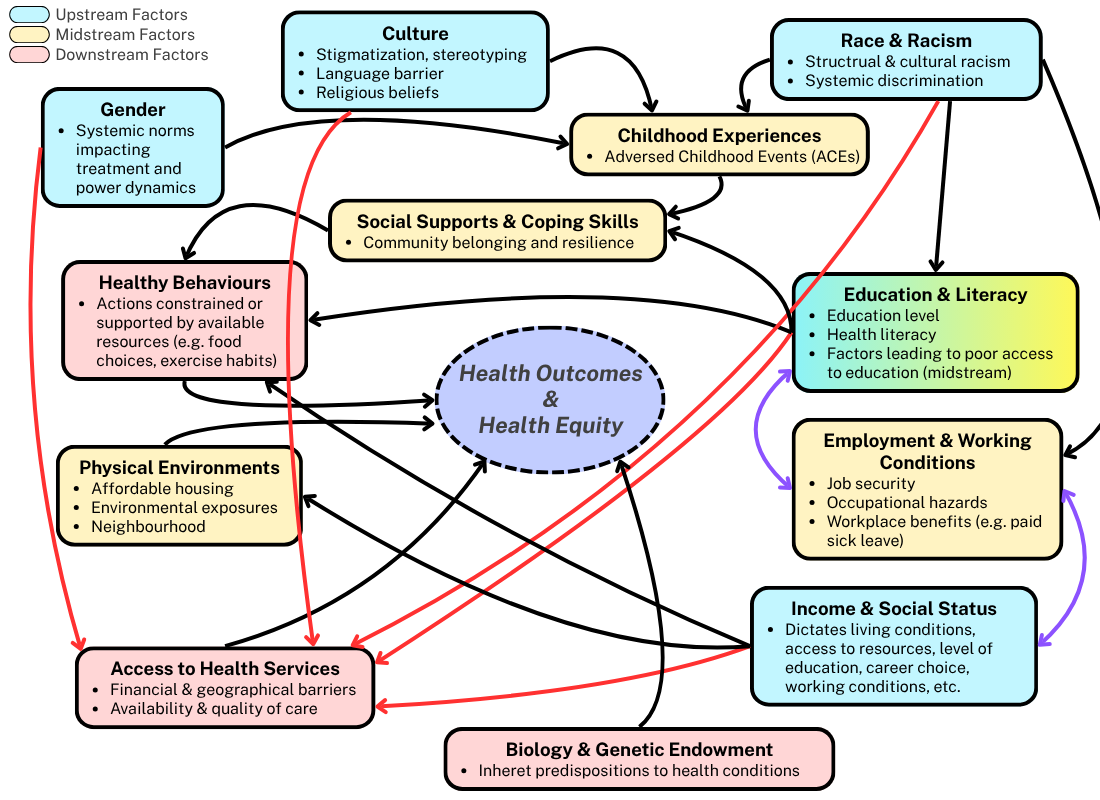
HLTH 4011 Portfolio. Click the concept map to view it full size.
Summary
My concept map illustrates the complex interplay between systemic forces and individual health outcomes, focusing heavily on how varying social determinants interact. Upstream structural elements, specifically gender, culture, race and racism, and income and social status, act as foundational drivers that shape midstream factors (physical environments, social supports and coping skills, employment and working conditions, and childhood experiences). A critical relationship highlighted in the diagram is that all upstream factors directly impact downstream access to health services, as indicated by the direct red arrows. Within these upstream elements, culture, and race and racism categories encompass stigmatization, language barriers, stereotyping, and systemic discrimination. These barriers foster implicit bias and culturally unsafe care, which impede access to quality health services.
Furthermore, I viewed education and literacy as a mix of upstream and midstream factors. This social determinant of health operates through a continuous feedback loop, as shown by the purple arrows, where education, employment and working conditions, and income mutually reinforce each other. This interconnected loop demonstrates that while income dictates educational access upstream, education simultaneously dictates employment security and future income midstream. Ultimately, the map emphasizes that downstream health behaviours and healthcare access cannot be effectively addressed without dismantling the upstream and midstream systemic structures that create barriers to health equity.
Personal Reflection
The link between education, employment, and income in my map reflects my own experience of working while pursuing higher education. When I was offered a better job with a different employer, I had to confront a difficult reality: I would have no extended health benefits until the mandatory probationary period of three months passed. Advancing my career had an immediate negative impact on my health care through out of pocket expenses for my medications and delay necessary dental care.
Refining My Map Through Peer Discussion
In the discussion forum, a classmate asked what policies or workplace supports could reduce gaps in health care coverage when people move between jobs. My response extends the education, employment, and income loop in my map:
This is a very difficult problem to solve. I once worked for an employer that required a six-month probation period before health benefit coverage started. On the other hand, I have heard of employers that waive the probation period for health benefits, recognizing the impact this gap can have on someone with a chronic health condition. Worth to note that social status and circumstances play a large role here. An individual whose partner has extended health coverage would not face the same barrier as a single parent, who would lose coverage for both themselves and their child.
BC’s income-based Fair PharmaCare helps with the cost of prescription drugs, dispensing fees, and some medical supplies. However, it calculates coverage using income tax data from two years prior (Government of British Columbia, n.d.), so it does not respond quickly to a sudden drop in income during unemployment or a probation period at a new job. The new national pharmacare program, launched in B.C. on March 1, 2026, removes cost barriers for any resident enrolled in MSP, but only for a limited list of medications: diabetes drugs, contraceptives, and menopausal hormone therapy (Government of British Columbia, 2026).
Because upstream factors have such broad effects, closing this gap would require changes to government policy. The B.C. government introduced the Employer Health Tax (EHT) in 2019 to replace revenue from Medical Services Plan (MSP) premiums, which were eliminated on January 1, 2020 (B.C. Ministry of Finance, 2018). I would propose shifting the cost of prescription medication to MSP, which medium and large employers already help fund through the EHT, instead of leaving it to private insurers to bundle with extended health benefits.
References
B.C. Ministry of Finance. (2018). Government moves forward on MSP premium elimination, tax cut for people [News release]. https://news.gov.bc.ca/releases/2018FIN0074-002013
Cusick, J. (2022). Post-secondary peer support training curriculum. BCcampus. https://opentextbc.ca/peersupport/front-matter/acknowledgements/
Government of British Columbia. (n.d.). Register for Fair PharmaCare. https://www2.gov.bc.ca/gov/content/health/health-drug-coverage/pharmacare-for-bc-residents/who-we-cover/fair-pharmacare-plan/register-for-fair-pharmacare
Government of British Columbia. (2026). National pharmacare in B.C. https://www2.gov.bc.ca/gov/content/health/health-drug-coverage/pharmacare-for-bc-residents/national-pharmacare
Public Health Agency of Canada. (2024, July 18). Social determinants of health and health inequalities. https://www.canada.ca/en/public-health/services/health-promotion/population-health/what-determines-health.html
TRU Open Learning. (n.d.). HLTH 4011 week 4: Social determinants of health [Course notes]. Thompson Rivers University.
Wakefield, M. K., Williams, D. R., Le Menestrel, S., & Flaubert, J. L. (Eds.). (2021). The future of nursing 2020–2030: Charting a path to achieve health equity. The National Academies Press. https://doi.org/10.17226/25982
World Health Organization. (2025, May 6). Social determinants of health. https://www.who.int/news-room/fact-sheets/detail/social-determinants-of-health